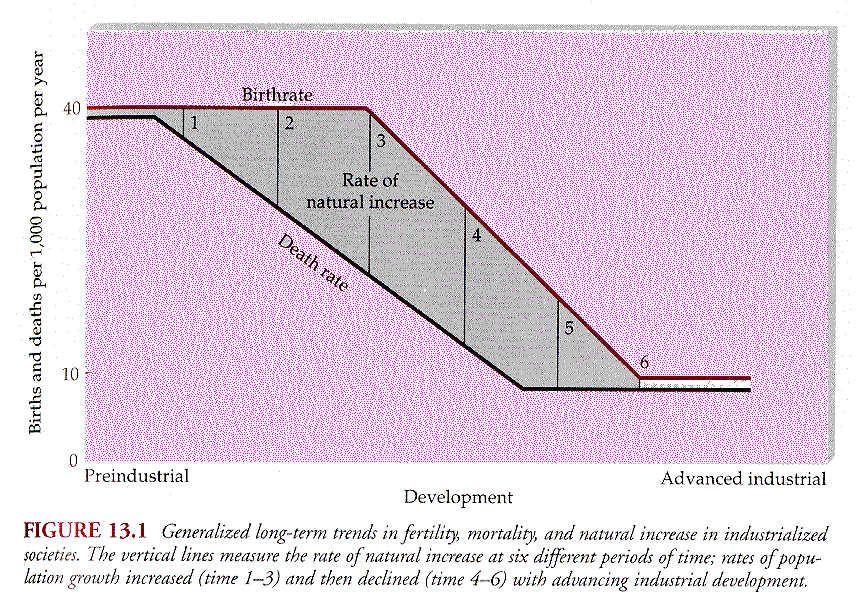
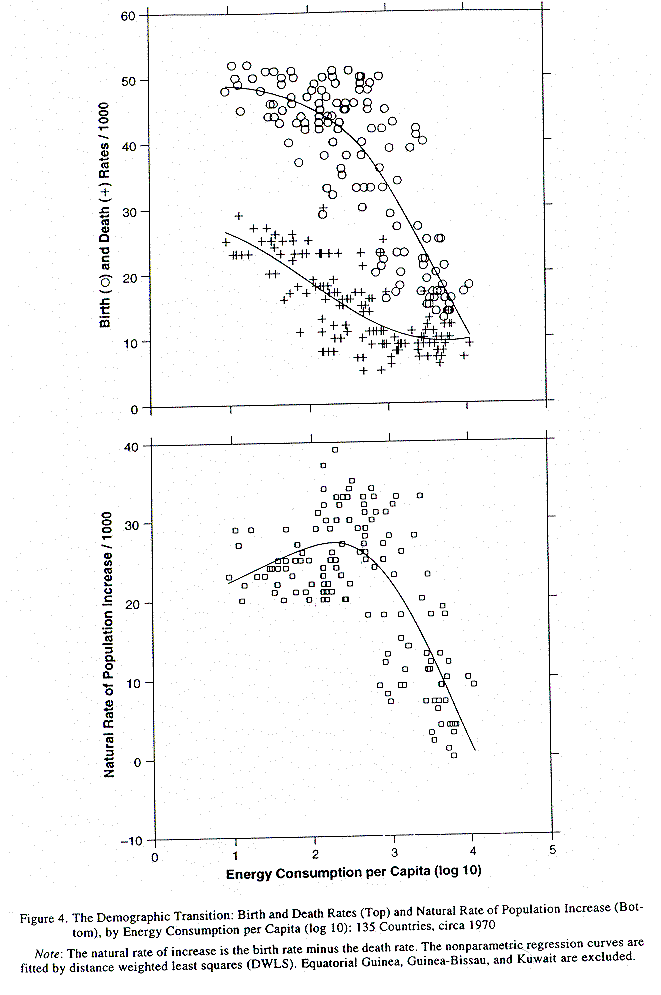
The lag between the decline in death rate and decline in birth rate produces a period of rapid population growth during the transition
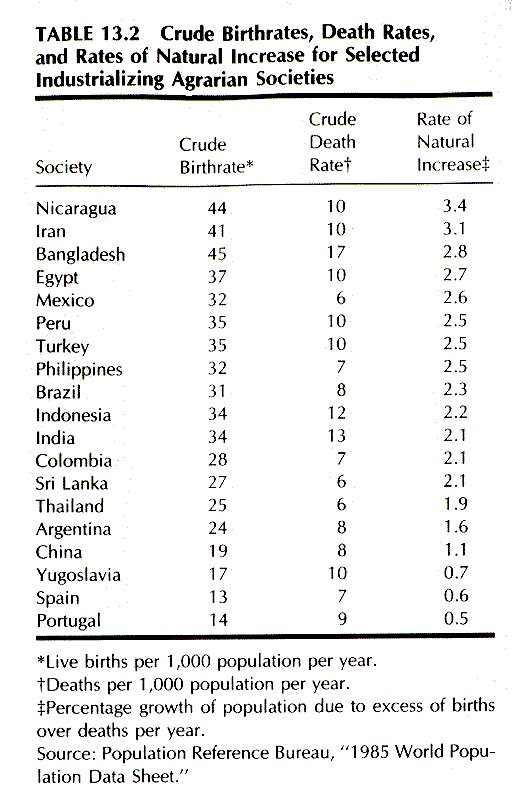
Exhibit: Crude birth & death rates of industrializing agrarian societies (HS 5th edition Table 13.2 p. 364)
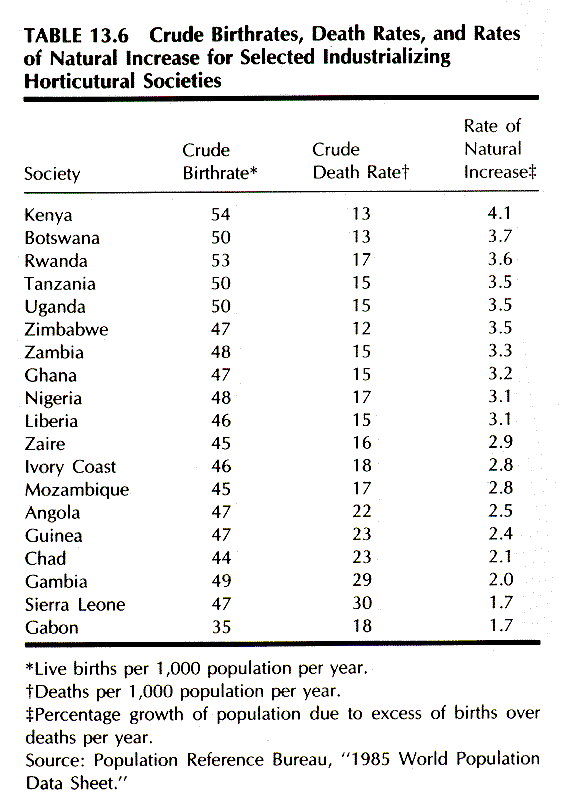
Exhibit: Crude birth & death rates of industrializing horticultural societies (HS 5th edition Table 13.6 p. 384)
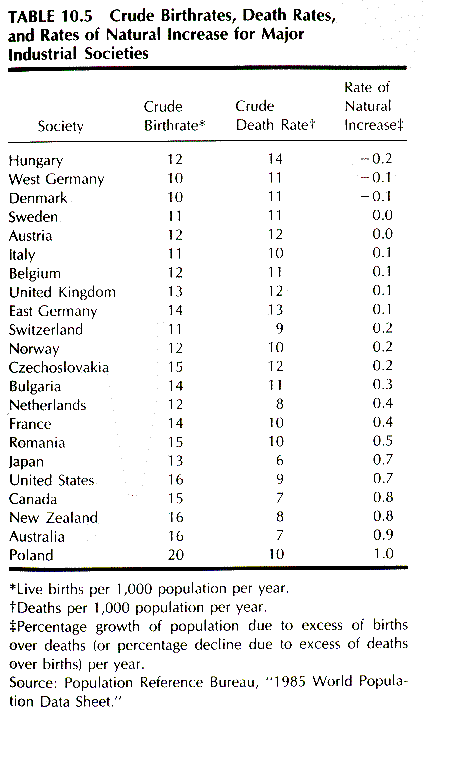
Exhibit: Crude birth & death rates of industrial societies (HS 5th edition Table 10.5 p. 271)
It is useful to keep in mind ballpark figures for the birth and death rates of 40 for agrarian societies, and 10 for industrial societies (births or deaths per 1,000 population per year)
Exhibit: The Demographic Transition - schematic representation (HS Figure 13.1 p. 307)
Exhibit: The Demographic Transition circa 1970 (Nielsen 1994 Figure 4 p. 663)
Q - In agrarian societies prior to the Industrial Revolution, birthrates (per 1,000 population per year) averaged about ___ while today in industrial societies they average about ___ ?
Q - The term "demographic transition" refers to what phenomenon?
Q - What role did the demographic transition play in the great improvement in living standards experienced by industrial societies?
A major factor of decrease in death rate and
increase in longevity was a tremendous decline in deaths due to communicable
diseases
| Cause of Death |
|
|
|
| Influenza and pneumonia |
|
|
|
| Tuberculosis |
|
|
|
| Gastritis, enteritis, etc. |
|
|
|
| Typhoid fever |
|
|
|
| Diphtheria |
|
|
|
| Smallpox |
|
|
|
| Measles |
|
|
|
| Scarlet fever |
|
|
|
| AIDS |
|
|
|
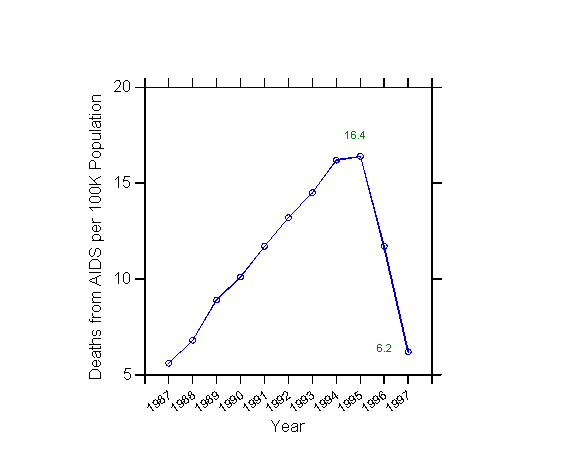
Comparison with the current AIDS epidemic:
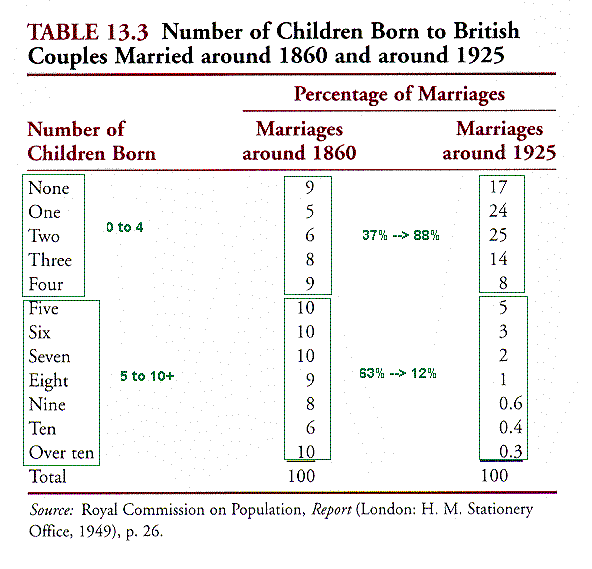
Exhibit: Children born to British couples ca. 1860 & ca. 1925 (HS Table 13.3 p. 314)
This trend reflects the general trend toward specialization in industrial societies
Q - Are there any functions of the family left?
Q - Compared to periods of economic prosperity, during an economic depression the divorce rate is:
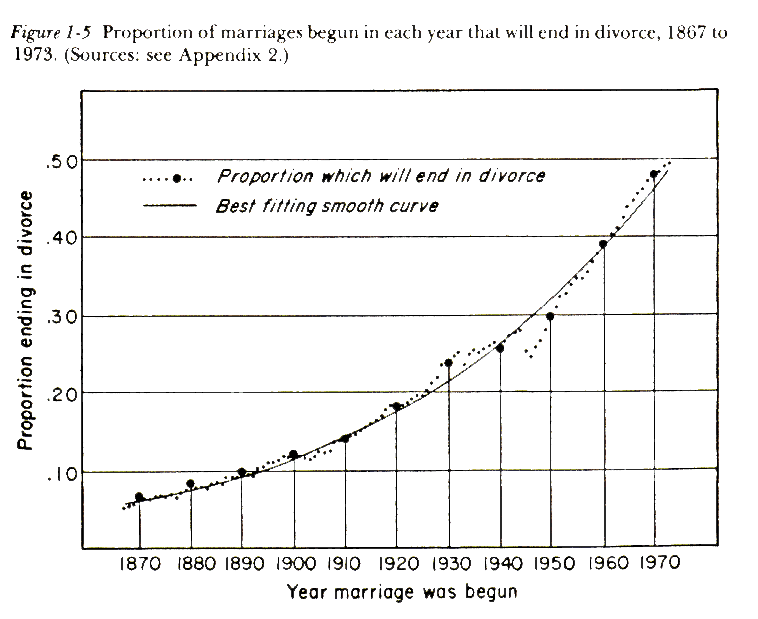
We can verify our intuition with a look at the historical trend in divorce rate in the U.S.:
Exhibit: Annual divorce rates in the U.S. 1860-1978 (Cherlin 1981, Figure 1-4 p. 22)We can also look at other social/historical trends that may affect divorce and use regression analysis to assess the impact of these trends on the divorce rate:
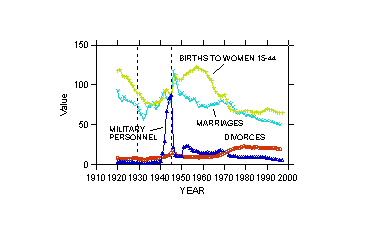
Exhibit: Divorce, unemployment, and female labor force participation - U.S. 1920-1996Q - What is the most important general explanation of the increase in the divorce rate in industrial societies?Exhibit: Marriage, births, and military personnel on active duty - U.S. 1920-1996
Exhibit: Time-series regression analysis of the divorce rate - U.S. 1920-1996
Q - Among industrial societies, in what country is the greatest income disparity between men and women found?
Why the income disadvantage of women?
Child-bearing role of women -> pattern of
interrupted employment ->
Q - How does the U.S. compare to other industrial societies with respect to participation of women in the polity? Why?
Q - "The most fundamental cause of change in the role of women in industrial societies is the emergence of feminist ideology." (TRUE/FALSE)?
Q - "Inequality between the sexes in modern industrial societies is less than it has ever been before in human societies." (TRUSE/FALSE)?
Q - "Among important causes of the continuing occupational disadvantage of women in industrial societies, sociologists include the lesser capacity of women for leadership." (TRUSE/FALSE)?
Q - "The term 'statistical discrimination' refers to the undercount of certain groups (such as Hispanic immigrants and homeless people) in population censuses." (TRUE/FALSE)?