"By the time we reached Miami [...] I gave up. I was a convert, and put myself in Hamilton's hands. I had undergone what historians of science call a paradigm shift." (Edward O. Wilson, Naturalist, p. 320)Note: If you are curious to know why Wilson was going to Florida; why he was taking the train rather than flying; and why he found it so difficult at first to accept Hamilton's reasoning, you can find the answers in his autobiographical book Naturalist.
The gist of Hamilton's theory is that to understand the evolution of behavior one must consider the effect of that behavior on the inclusive fitness of the individual organism:
Inclusive fitness of individual organism = own reproductive success + reproductive success of kin multiplied by degree of relatedness
Altruistic behavior is behavior that is beneficial to others at a cost in fitness (reduced reproductive success) for the organism engaging in the behavior, such as the call of a bird warning of the presence of a predator.For example, a gene for producing a warning call when sighting a predator represents a cost c for the bird emitting the call, as the calling bird will be more likely to be spotted and attacked by the predator. The call represents a fitness benefit b for other birds who are warned by the call and able to take cover from the predator. To the extent that beneficiaries of the call include relatives (siblings, parents, offspring,...) of the calling bird, the inclusive fitness of the calling bird is increased; the altruistic behavior will be selected to the extent that the overall fitness benefit for relatives (weighted by the degree of relatedness) is greater than the individual fitness cost c.Altruistic behavior can evolve by natural selection if it increases inclusive fitness of the individual by increasing the survival and reproduction of relatives who share a proportion of genes by common descent.
Hamilton stated mathematically that an altruistic gene is selected (i.e., will spread in the gene pool) if
c < rb
where:
c = cost of the behavior in terms of individual fitness
b = fitness benefit to relative
r = coefficient of relatedness ( = probability that relative also carries the altruistic gene by common descent)
Hamilton's theory explains the evolution of nepotistic altruism (= altruism benefiting relatives; from Latin nepos = "nephew")
Coefficients of relatedness r ( = fraction of genes identical by descent) for various relatives in a random-mating diploid population:
Parent-offspring 1/2
Full siblings 1/2
Half siblings 1/4
Uncle/Aunt - Nephew/Niece 1/4
First cousins 1/8
There are many examples of nepotistic altruism aka kin selection in nature.
"Maternal instinct", the propensity of mothers and parents in general to defend their young is the most obvious consequence of nepotistic altruism. (It is so conspicuous and pervasive as to be taken for granted.)
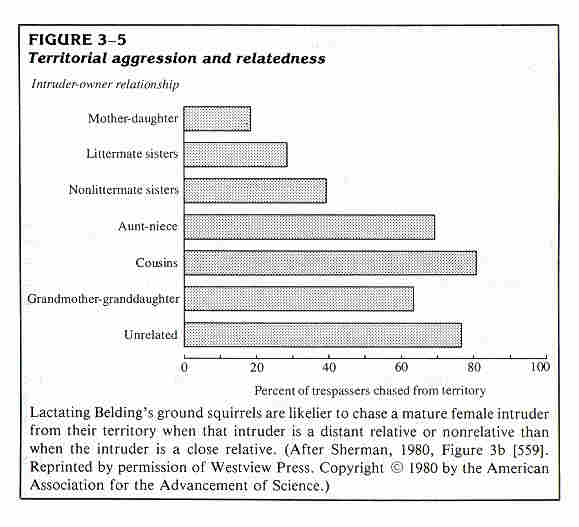
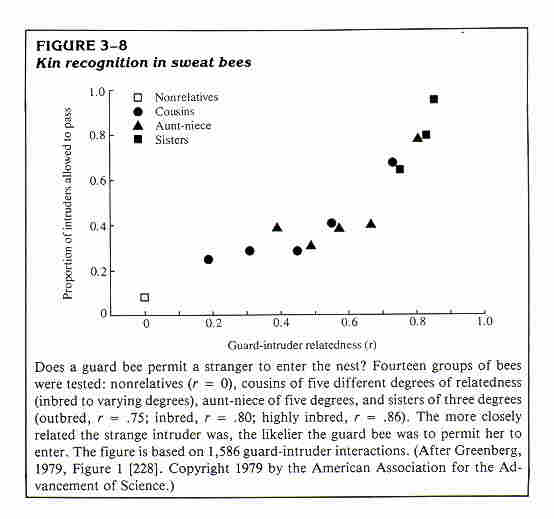
The evolution of nepotistic altruism is manifested by the evolution of kin-recognition mechanisms in many species. Kin-recognition mechanisms allow organisms to evaluate the degree of relatedness of strangers. Kin-recognition mechanisms have been found in mammals as well as insects:
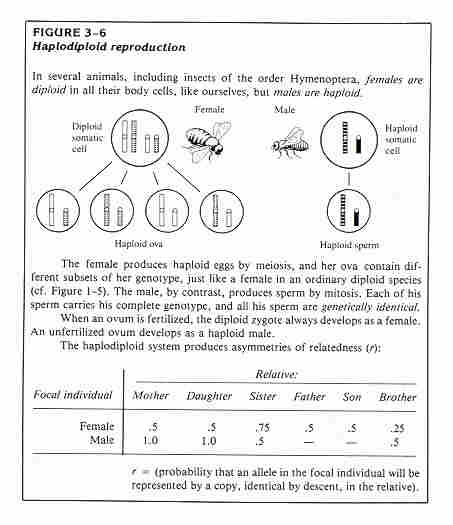
One triumph of Hamilton's theory was his explanation of the evolution of eusociality in hymenoptera (the group of insects that includes bees and ants). Eusociality (or "good sociality") refers to animal societies such as bees in which the workers are sterile; only the queen reproduces. Hamilton argued that the basis of eusociality in bees is their special haplodiploid genetic system. One consequence of haplodiploidy is that a female bee shares 75% of her genes with her sister but only 50% of her genes with her own offspring (daughter or son). Thus a female can reproduce more of her genes by being a sterile worker helping to produce sisters, i.e. daughters of the queen, than by having daughters on her own!
Q - Under what conditions can altruistic behavior (i. e., a behavior that reduces the fitness of the individual but benefits others) evolve under natural selection?
Q - What are the components of Hamilton's inclusive fitness?
Q - What does "nepotism" mean?
The nature of incest was discussed in the media in the wake of the relationship between Woody Allen and Soon-Yi Previn. Some elements of that situation are:
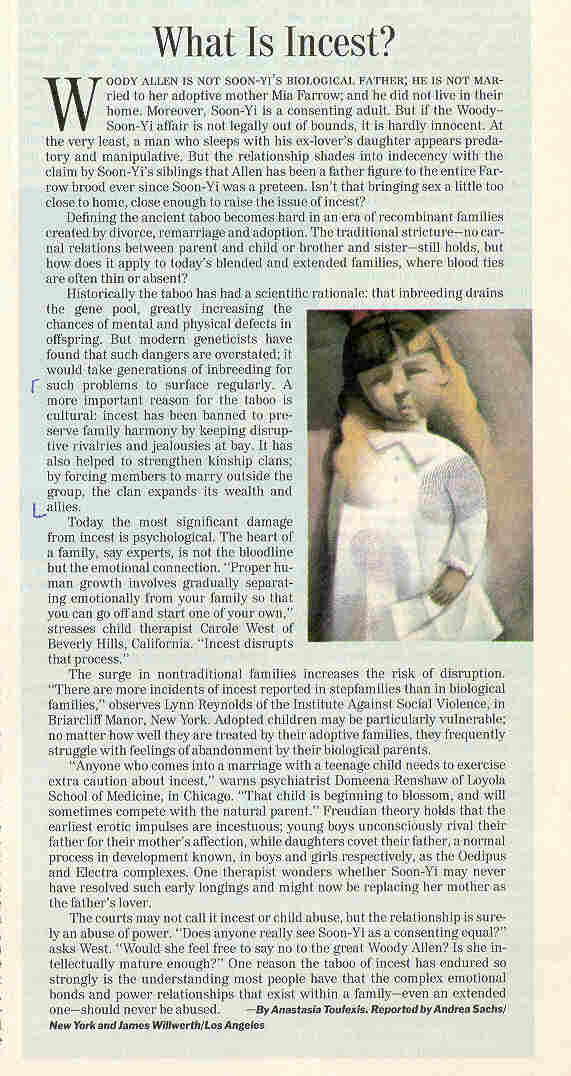
The following article about the relationship of Woody Allen with Soon-Yi illustrates traditional theories on the origin of incest avoidance and misconceptions about biological consequences of incest.
Traditional cultural theories of the incest taboo explain incest avoidance as
"Incest taboos are the cultural expression of a biological predisposition not to breed with close relatives [...] The cultural significance of incest taboos has been much exaggerated in the anthropological literature" (Pierre van den Berghe, Human Family Systems, p. 117)Q - What is a kibbutz?
Q - The finding that unrelated children raised together in Israeli kibbutzim do not have sexual relations as adults is an instance of what phenomenon?